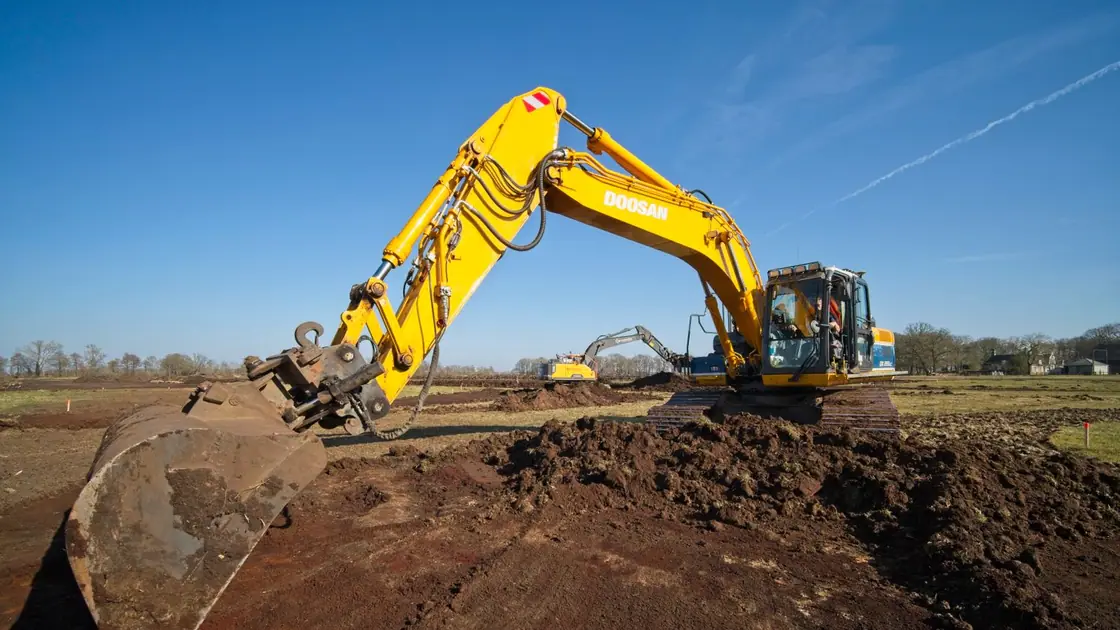
A bank cubic yard dug from the ground, a loose cubic yard in a stockpile and a compacted cubic yard in finished fill describe different bulk states. Understanding swell and shrinkage prevents incorrect truckload estimates and unverified backfill orders.
Bank, loose and compacted cubic yards
Bank cubic yards (BCY) represent material in its original undisturbed position. Loose cubic yards (LCY) measure bulk excavated or stockpiled material after disturbance. Compacted cubic yards (CCY) describe a placed volume compacted to a specified condition. These names identify volume state, not three different fixed units.
The FHWA earthwork design guide ↗ explains that most excavated materials change bulk volume when moved from cut to fill. A single mass of soil can occupy more space in a truck than it did in the ground, then change bulk volume again during placement and compaction.
If a supplier quotes truckloads in loose yards while the project specifies compacted fill, a one-to-one assumption is not justified without material-specific information.
Swell: why excavated material occupies more space
Swell describes the increase in bulk volume when a soil or rock mass is broken loose. The process changes the arrangement and void spaces between particles. Moisture, soil structure, rock fragmentation and original density influence the resulting expansion. Swell factors are usually expressed as a ratio or percent relative to bank volume.
An illustrative formula is loose volume = bank volume × (1 + swell percentage ÷ 100). If an earthwork report provides a 20% swell factor for the actual material and the excavation is 15 bank cubic yards, the scenario's loose volume is 15 × 1.2 = 18 loose cubic yards.
That 20% is an arithmetic example, not a default for all soils. A project value may be determined from samples, past work, site documentation or geotechnical methods; use the source stated by the project rather than a generic online table.
Shrinkage: what happens in compacted fill
Shrinkage in earthwork refers to the difference between an original in-place volume and the final compacted fill volume, for a given mass of suitable material. The conversion may be expressed relative to bank volume or through dry density, depending on the contract. Clarify the ratio's direction and the reference state.
Suppose a project's documented ratio states that 15 bank cubic yards of suitable soil will produce 13.5 compacted cubic yards under the specified conditions. The compacted-to-bank ratio is 0.90. That ratio should not be used for another site or soil without validation.
Because a project can import soil, discard unsuitable material or lose fines during processing, simple volume ratios are not a complete mass-balance model.
Density, moisture and pore space
Soil bulk density is mass divided by bulk volume, including the pore spaces between particles. Compaction reduces pore space and commonly increases dry bulk density. Moisture affects the ease of compaction and total wet weight. The USDA NRCS soil compaction note ↗ describes the relation between bulk density and pore space.
Engineering specifications may define a target dry density or laboratory reference such as a Proctor compaction test. A percentage of maximum dry density does not directly equal a percentage reduction in cubic yards, and the two should not be substituted.
Successful fill design also considers material suitability, layer thickness, moisture conditioning and field verification. A volume calculator cannot certify any of these conditions.
Example earthwork quantity ledger
The table represents a single hypothetical quantity using two separately documented conversion assumptions. The factors are examples only and are intentionally shown as inputs rather than inferred material properties.
A 15-BCY cut may yield 18 LCY under an assumed 1.20 loose-to-bank factor, and 13.5 CCY under an assumed 0.90 compacted-to-bank factor. These are different observations of the same originally measured quantity, not a claim that 18 loose yards can be purchased to make 13.5 compacted yards on every site.
| State | Illustrative factor | Calculated volume |
|---|---|---|
| Undisturbed bank | Reference 1.00 | 15.0 BCY |
| Excavated loose | 1.20 × bank | 18.0 LCY |
| Placed compacted | 0.90 × bank | 13.5 CCY |
Why a generic 10%, 20% or 30% factor is risky
Materials respond differently to excavation and compaction. A granular soil, highly organic soil and weathered rock may have different void structures. A number commonly used for another soil, haul condition or machinery setup could understate or overstate purchase quantities. A simple calculator's 'extra allowance' input is not equivalent to a verified swell or shrinkage factor.
Ask whether the project quantity is measured in bank, loose or compacted state and where the factor originated. If the specified finished fill is 20 CCY, determine the actual project conversion to delivered loose yards before scheduling material, rather than adding a guessed fixed percentage.
Cut-and-fill balancing versus material importing
Earthwork planning often attempts to use suitable material excavated from a cut area to create the required fill elsewhere. The original bank cut may not provide enough compacted fill after unsuitable material is removed, and a balanced bank volume does not guarantee a balanced finished fill volume.
The FHWA earthwork design guidance ↗ describes borrow and waste considerations. Hauling routes, material suitability, moisture and compaction requirements can influence how much material must be imported or disposed of.
For small project geometry, start with the excavation calculator and fill dirt calculator. Larger projects may require surveys and engineered earthwork models.
What a homeowner should confirm before ordering
Identify whether the project needs landscaping topsoil, general nonstructural fill or engineered structural fill. Establish the required finished elevation and depth using measured grades. Confirm which soil product is specified and whether the supplier quotes loose yards or weight. Do not use topsoil for structural fill merely because it is readily available.
When backfilling trenches or building pads, project safety, permits and material specifications are separate from the volume arithmetic. Obtain qualified advice for structural or significant earthwork and do not assume a calculator can determine compaction acceptance.
How to document material-state factors in a project estimate
Rather than storing only one 'waste factor,' record bank volume, loose haul volume and required compacted fill volume as separate quantities. For each conversion, note the factor's numerical value, whether it is applied as a multiplier or divisor, the source of the factor and the material state being compared.
For example, a project might document a loose-to-bank multiplier of 1.18 for a particular material. You should not use it to convert compacted yards back to bank yards without additional information. Factor direction matters; applying a ratio backward can magnify an error even when the percentages appear reasonable.
Volume calculations and field compaction testing are different tasks
A rectangular layer's volume can be calculated from dimensions alone. Field compaction verification may involve measured dry density, moisture content, laboratory reference density and specified acceptance criteria. That testing does not follow automatically from the number of cubic yards entered into a planning tool.
When a specification references a particular percentage of laboratory maximum dry density, it is referring to density performance under defined methods. It is not a direct statement of shrinkage by that percentage. Projects where stability or settlement matters should follow the appropriate geotechnical and construction requirements.
Frequently Asked Questions
What does BCY mean?
BCY means bank cubic yards, the volume of undisturbed in-place earth before excavation.
What does LCY mean?
LCY means loose cubic yards, the bulk volume after material is dug or stockpiled.
What does CCY mean?
CCY means compacted cubic yards, the volume of placed fill compacted to the specified condition.
Is a 20% swell factor always correct?
No. Swell varies by material and field conditions. Use a project-supported factor.
Does 95% Proctor compaction mean 5% less volume?
No. It refers to a specified percentage of a laboratory reference dry density, not a direct percent volume change.
Can I calculate imported loose fill from finished cubic yards alone?
Only with applicable material-state conversion factors or density data. The relationship cannot be determined universally from the finished volume.
Are bulk density and particle density identical?
No. Bulk density includes pore spaces in the material volume; particle density describes the solid phase.
References and calculation limits
Exact unit relationships are mathematical; material properties, practical ordering factors and local conditions require supplier or project-specific verification. The following publications support the relevant technical context.
For the site's core formulas and density limitations, see our Calculation Methodology. Need a different tool? Open the cubic yard calculator homepage or browse all related guides.
Related Calculators and Guides
Continue with a material-specific estimate, convert units, or review the calculation behind your result.